Cascais to Regulate Short-Term Rentals in 2026: What It Means for Hosts
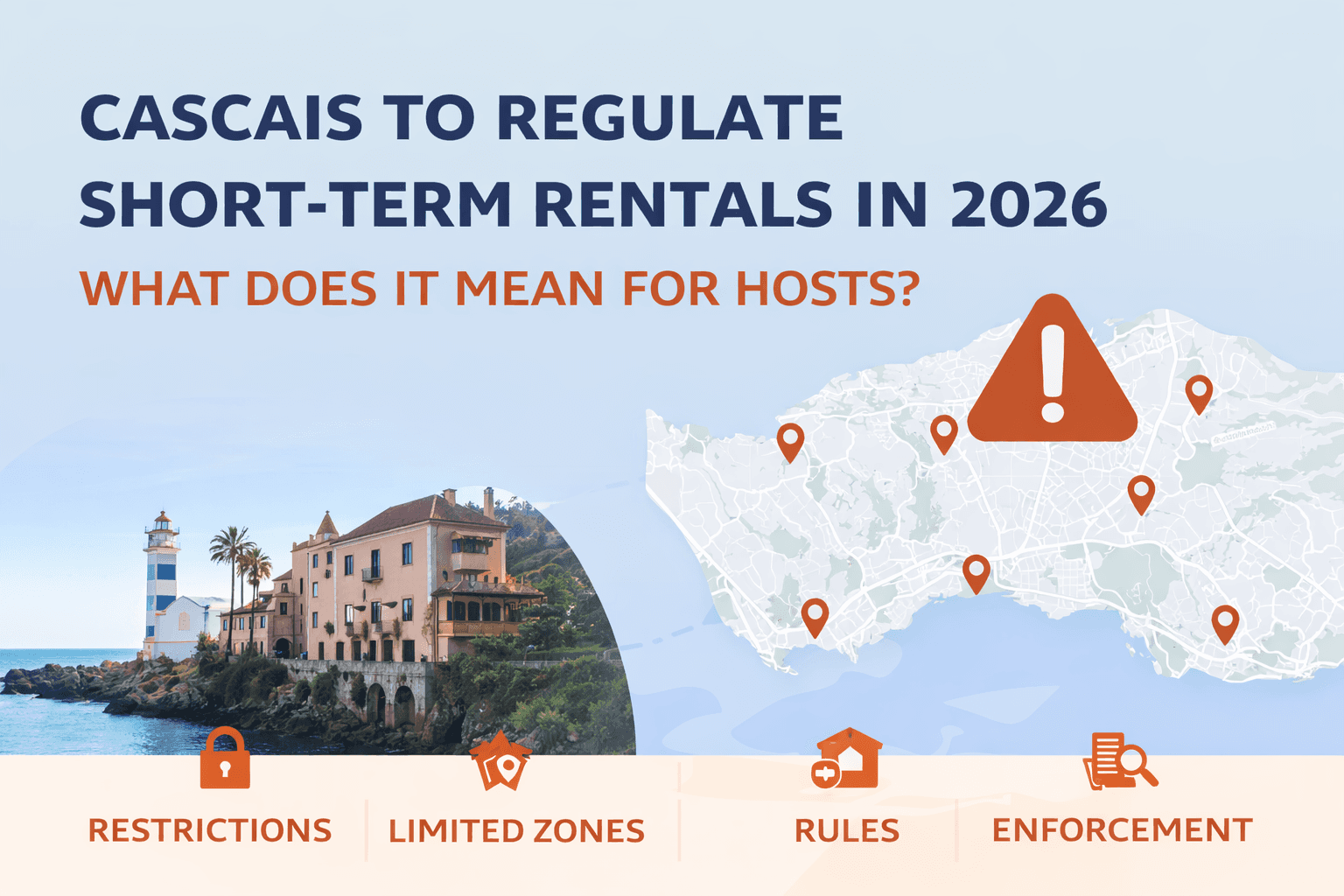
The Municipality of Cascais has officially started the process of creating a new regulatory framework for short-term rentals (Alojamento Local).
This decision comes at a moment when pressure on the sector is increasing nationwide. Just this week, the Portuguese government approved a decree-law extending until 31 December 2026 the deadline for municipalities with more than 1,000 AL registrations to decide whether to create their own regulation — and allowing them, exceptionally, to suspend new AL registrations while they draft those rules.
In other words: Cascais is not an outlier. It's part of a wave. Here's what it actually means for hosts.
Key dates at a glance
October 2024 — Municipalities gained the power to adopt their own administrative regulation defining procedures and enforcement for AL in their territory
December 2025 — Lisbon's amended AL regulation entered into force, setting the template other municipalities are watching, with a municipal containment ratio of 10% of housing stock per parish
2026 (ongoing) — Cascais council approved the start of drafting its own AL regulation, citing around 2,760 registered units
June 2026 — The government approved a decree-law extending until 31 December 2026 the deadline for municipalities with 1,000+ AL units to decide on a regulation, and allowing temporary suspension of new registrations during drafting. The suspension does not affect existing registrations
After publication — A 10-day public consultation period opens once Cascais publishes its draft regulation
Why is Cascais regulating short-term rentals?
According to the official documentation, there are several key reasons:
Cascais has around 2,760 registered short-term rentals
Portuguese law requires municipalities with more than 1,000 AL units to expressly decide, within 12 months of reaching that threshold, whether they will exercise their regulatory powers
There are growing concerns about:
Housing shortages for residents
Urban pressure and over-tourism
Social impact on neighborhoods
In practical terms, the growth of short-term rentals is pushing the municipality to act — and national law is now actively encouraging it.
What could change under the new regulation?
Although still in early stages, the regulation may introduce:
Containment zones Specific areas where new short-term rental licenses may be restricted or not allowed. Municipalities can define containment areas per parish, in whole or in part, and impose limits on the number of AL establishments, including percentage limits relative to available housing.
Limits per area A maximum number of rentals per parish or zone, controlling density. For reference, Lisbon's new regulation set this ratio at 10% per parish.
Usage rules Restrictions on what types of properties can operate as short-term rentals, particularly in residential buildings. In containment areas, the same owner can operate a maximum of 7 AL establishments, and registration numbers become personal and non-transferable.
Temporary suspension of new registrations This is the newest risk for anyone planning to open in Cascais. Under the June 2026 decree-law, municipalities can suspend new AL registrations for the time strictly necessary to draft their regulation.
Stronger enforcement This is already happening. Cascais was among the municipalities (alongside Lisbon and Sintra) that began notifying AL operators who had not submitted their mandatory liability insurance on the platform.
What happens next?
The council approved three key steps:
Start drafting the regulation
Publish it on the municipality's official website
Open a 10-day public consultation period
This means hosts and stakeholders will have the opportunity to submit feedback before the regulation is finalized.
Does this affect current hosts?
At this stage:
There is no immediate impact
Existing licenses are not affected — even a suspension of new registrations explicitly does not touch existing registrations
However, in the future:
Opening new short-term rentals may become more difficult, or temporarily impossible during the drafting period
Certain areas may become containment zones
Additional compliance requirements may be introduced
Licenses in containment zones may become non-transferable, affecting resale value of AL properties
What should hosts do now?
If you own or plan to operate a short-term rental in Cascais:
If you're planning to register a new AL, do it sooner rather than later — a suspension during drafting is now legally possible
Monitor the publication of the draft regulation and participate in the public consultation
Make sure your existing registration is fully in order: insurance submitted, RNAL data up to date, activity proven
Ensure full compliance with current legal obligations (SIBA, INE, tourist tax)
Many hosts only react when enforcement begins, which is often too late. With Cascais already running insurance notifications, enforcement is no longer theoretical.
How to stay compliant without added complexity
Operating a short-term rental in Portugal involves multiple obligations:
Reporting guest data through SIBA within 3 days
Submitting monthly statistics to INE (IPHH)
Managing tourist tax requirements — Cascais is one of the municipalities that charges a municipal tourist tax
Handling invoicing and tax reporting
Tools such as EazyAL are designed to simplify this process:
Automatic collection of guest data before arrival
Preparation of required information for submissions
A simplified interface compared to official government portals
This becomes increasingly relevant as regulations tighten and enforcement increases.
FAQ
What are containment zones in short-term rentals? They are areas where municipalities limit or restrict new short-term rental licenses to control housing pressure. They can cover an entire parish or only part of it, and typically include a cap on AL density as a percentage of the housing stock.
Has Cascais banned new short-term rentals? No. The municipality has only initiated the process of creating a regulation. However, under the new June 2026 decree-law, Cascais could legally suspend new registrations while the regulation is being drafted — so the window for new registrations may not stay open indefinitely.
Can Cascais suspend new AL registrations before the regulation exists? Yes. The government's June 2026 decree-law exceptionally allows municipalities to suspend or re-apply a suspension of new AL registrations, but only for the time strictly necessary to draft their regulation.
Will existing hosts be affected? Not immediately. Existing registrations are protected from suspensions. But the final regulation may introduce new requirements — and if your property ends up in a containment zone, your license could become non-transferable, which affects what happens if you sell the property.
What happens to my license if I sell my property in a containment zone? In containment areas, AL registration numbers for the "moradia" and "apartamento" modalities are personal and non-transferable, and the license lapses if ownership of the registration is transferred. The buyer would need a new license — which may not be granted. This is one of the most underestimated financial impacts of containment zones.
Can hosts participate in the process? Yes. There is a 10-day public consultation period after the draft regulation is published on the municipality's website. Hosts, property managers, and industry associations can submit comments before the rules are finalized.
How long does Cascais have to finish the regulation? The national deadline for municipalities with more than 1,000 AL units to decide on regulation was extended to 31 December 2026, so expect the Cascais process to move within that timeframe.
What did Lisbon do, and is it a preview of Cascais? Likely yes. Lisbon's amended regulation, in force since December 2025, is the reference model: it set a containment ratio of 10% of housing per parish, combined with stricter rules in saturated areas. Cascais will draft its own rules, but the toolkit available to it is the same.
Is enforcement actually happening, or is this just paperwork? It's happening. Cascais, alongside Lisbon and Sintra, has already started notifying AL operators who failed to submit their mandatory insurance. Compliance gaps that were ignored for years are now being actively checked.
Will other cities follow this approach? Yes. Lisbon and Porto already have regulations in force, and municipalities including Sintra, Vila Nova de Gaia, and Viana do Castelo have suspended or restricted new registrations, with others such as Odivelas, Vila do Conde, and Braga preparing to follow.
If you want to stay compliant and avoid unnecessary risk, consider automating your guest reporting, INE submissions, and operational workflows. Tools like EazyAL are designed specifically for hosts operating in Portugal.