INE & SEF Reporting in Portugal: What Hosts Get Wrong Every Month
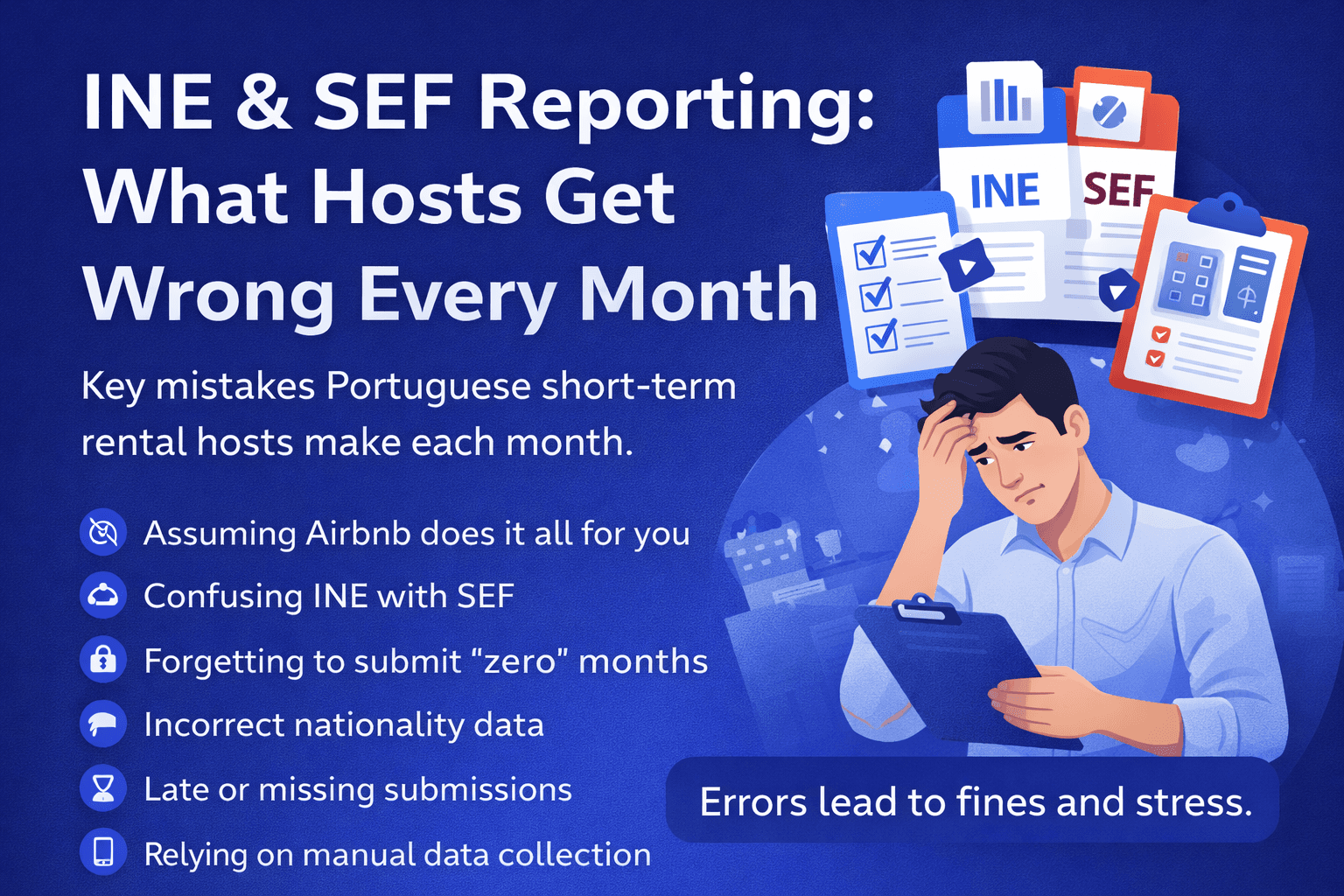
INE & SEF Reporting: What Hosts Get Wrong Every Month
If you host short-term rentals in Portugal, there are two reporting obligations that quietly cause stress, mistakes, and fines every single month. They are INE (Statistics Portugal) reporting and SEF / AIMA guest registration.
Most hosts don’t intentionally ignore these rules. They simply misunderstand them.
This article breaks down what hosts get wrong every month, why it happens, and how to avoid problems without turning hosting into a bureaucratic nightmare.
“Airbnb Handles This for Me” (It Doesn’t)
This is the most common—and most dangerous—assumption hosts make: Airbnb does not handle legal compliance for you. It does not submit your INE monthly statistics, does not register guest passport details with SEF/AIMA, and does not protect you from fines if information is missing or submitted late. Airbnb is simply a booking platform, not a compliance service—and if your property has an AL license, the legal responsibility is entirely yours.
Confusing INE With SEF (They Are Not the Same)
Many hosts mix these two together. They are separate obligations.
INE reporting (monthly)
This reporting is statistical in nature, based on aggregated data and focused on metrics such as nights stayed, number of guests, and nationalities. It must be submitted monthly, even in months where there were zero stays.
SEF / AIMA reporting (per stay)
This falls under legal and security obligations and requires individual guest details, including passport or ID information, to be submitted for each arrival and within strict legal deadlines. Crucially, submitting one requirement does not satisfy the other—each obligation must be handled separately to remain compliant.
Forgetting to Submit “Zero” Months (INE)
A very common mistake is assuming that no guests means no submission. That’s wrong. INE still expects a report, even if the property was empty, the calendar was blocked, renovations were ongoing, or you were abroad. Failing to submit a “zero” report still counts as non-compliance and can result in penalties.
Incomplete or Incorrect Nationality Data
INE reporting relies heavily on guest nationality, and this is where many hosts go wrong. Common mistakes include guessing a guest’s nationality, using country of residence instead of nationality, leaving the field blank, or grouping guests incorrectly. While these may seem like small errors, they accumulate over time and can invalidate your reports. INE doesn’t just care that data is submitted—it cares that the data is accurate and logically consistent.
Late SEF / AIMA Submissions
Guest registration is subject to strict timing rules, and many compliance issues come from small oversights—submitting after the deadline, forgetting guests who arrive late at night, missing one person in a group, or assuming that self check-in changes the rules (it doesn’t). Late or incomplete submissions can result in fines, official warnings, and increased scrutiny in the future.
Relying on Manual, Message-Based Data Collection
Many hosts still collect guest details through a patchwork of methods—asking via Airbnb chat, sending multiple reminders, chasing guests on WhatsApp, and then copy-pasting everything into government portals. This approach leads to guest annoyance, missing information, last-minute stress, and errors under pressure. The issue isn’t the host—it’s a broken, manual process.
No Audit Trail or Proof of Submission
Another often overlooked issue is the lack of proof: no record of what was submitted, no timestamps, no saved confirmations, and no reliable way to demonstrate compliance later. If a dispute ever arises, “I think I submitted it” is not a defence.
The Real Issue: Reporting Is Treated as Messaging
Most compliance problems arise because reporting is managed through chats, reminders, and manual follow-ups. But compliance isn’t about communication—it’s about data flow. When reporting depends on human memory and message replies, mistakes aren’t just possible; they’re inevitable.
What Good Looks Like
Well-run hosts typically rely on a single, structured guest intake flow, with one clear place for guests to submit all required information. They maintain a clean separation between the guest experience and legal reporting, which allows monthly statistics to be generated calmly and accurately—rather than rushed at the last minute.
EazyAL helps by turning compliance into a clean, automated data flow instead of a manual chore. Guests enter their details once through a structured, secure intake link, eliminating back-and-forth messages, reminders, and copy-paste errors. That same data is then validated, stored with timestamps and proof of submission, and used to generate the correct outputs for each obligation—guest registration and monthly INE statistics—without duplication or guesswork. For hosts, this means clear separation between guest experience and reporting, calm monthly submissions (including zero reports), and the ability to prove compliance at any time if questions or audits arise.
FAQ
Q: Does Airbnb submit INE statistics on behalf of AL hosts in Portugal? A: No. Airbnb is a booking platform and does not handle INE monthly reporting or SEF/AIMA guest registration. AL hosts are legally responsible for both obligations.
Q: Do I need to submit an INE report if I had no guests that month? A: Yes. INE requires a monthly submission regardless of occupancy. Failing to submit a zero report still counts as non-compliance and may result in penalties.
Q: What is the difference between INE reporting and SEF/AIMA registration? A: INE reporting is a monthly statistical obligation covering aggregated data like guest nights and nationalities. SEF/AIMA registration is a per-stay legal obligation requiring individual guest passport or ID details. They are separate requirements and must each be handled independently.
Q: What happens if I submit guest details to SEF/AIMA late? A: Late submissions can result in fines, official warnings, and increased regulatory scrutiny. The rules apply regardless of how guests checked in — including self check-in.
Q: How can AL hosts automate INE and SEF/AIMA reporting? A: Tools like EazyAL collect guest data through a single structured intake link, validate it, store it with timestamps, and generate the correct outputs for both INE and SEF/AIMA — replacing manual follow-ups and copy-paste errors with a clean, automated data flow.