The 5 Government Portals Every Airbnb Host in Portugal Must Use
The 5 Government Portals Every Airbnb Host in Portugal Must Use
Hosting short-term rentals in Portugal isn’t just about welcoming guests.
Behind the scenes, hosts are required to submit data to multiple government platforms, each with a different purpose, schedule, and level of risk if handled incorrectly. Many fines and warnings don’t happen because hosts ignore the law—but because they don’t realize how fragmented the system is. Below is a clear breakdown of the key portals every AL host must deal with, and where things most often go wrong.
Monthly Statistics – Instituto Nacional de Estatística (INE)
The INE portal collects tourism data to track occupancy rates, guest nights, and visitor nationalities across Portugal.
Hosts are required to submit monthly reports per property, including:
Total number of guests
Number of overnight stays
Guest nationalities
Even if you had zero bookings, you are still required to submit a report.
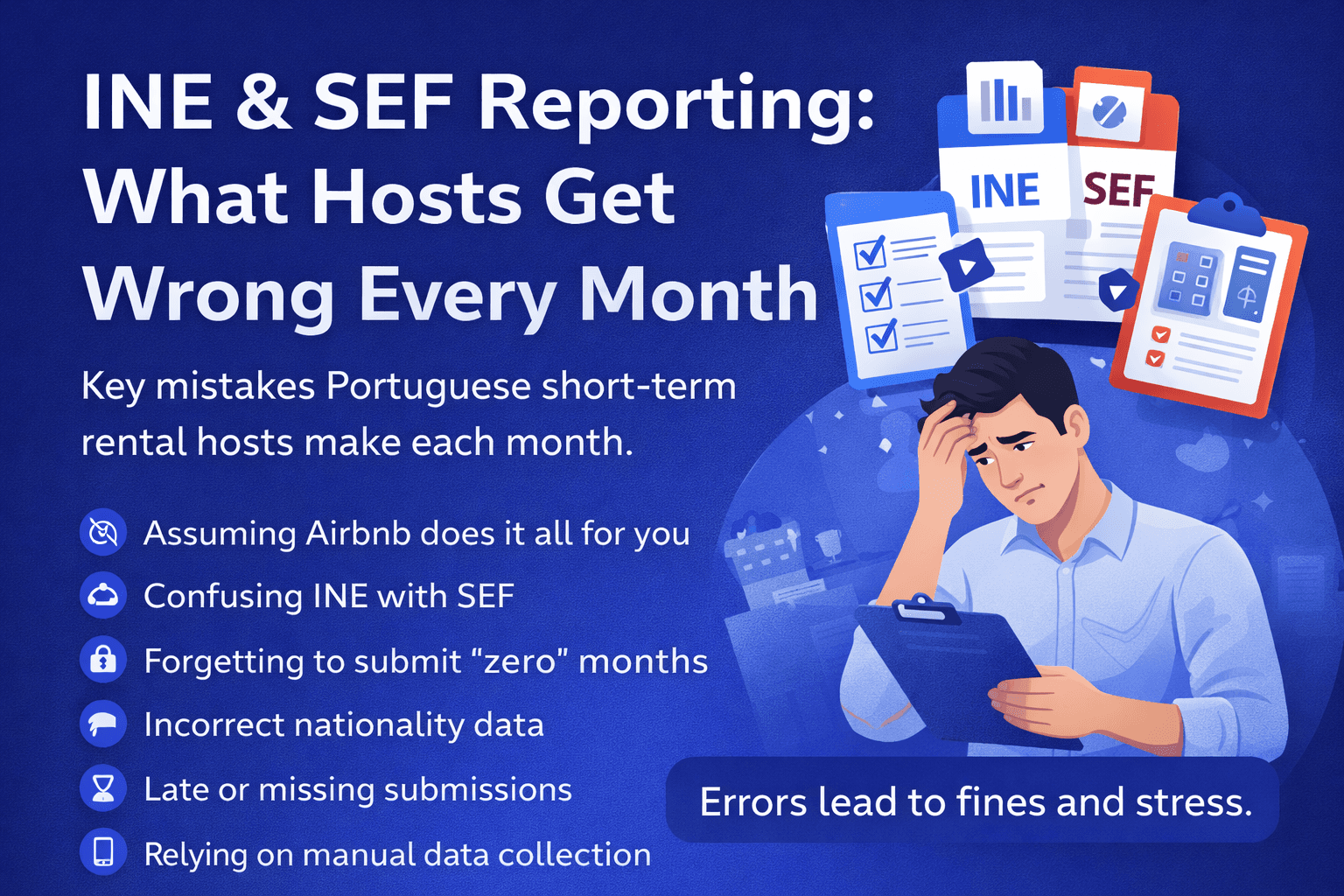
Assuming Airbnb submits this automatically
Skipping months with no guests
Incorrectly counting guest nationalities
Missing submission deadlines
This is one of the most frequently overlooked legal obligations for Airbnb hosts in Portugal.
Finanças – Autoridade Tributária
The Finanças portal handles all tax-related obligations tied to your rental activity.
Hosts must:
Declare rental income under the correct activity code
Link their AL license to their NIF
Issue invoices (where applicable)
Comply with IVA (VAT) rules depending on their tax regime
Submit annual IRS or IRC declarations
Common mistakes:
Mixing personal and rental income
Using the wrong CAE/activity code
Assuming Airbnb pays or handles all taxes
Failing to issue proper invoices
This is the area where professional accounting support is highly recommended.
Tourist Tax – Municipal Portals
MMany Portuguese cities charge a per-night tourist tax, managed through local municipal platforms.
Hosts must report:
Number of taxable nights
Guest totals
Applicable exemptions (e.g., children, long stays)
Reporting frequency varies by municipality—typically monthly or quarterly.
Common mistakes:
Forgetting to submit during low season
Misapplying exemptions
Paying late or missing deadlines
Assuming Airbnb collects and remits taxes everywhere
Since rules vary by city, this is a major source of confusion for hosts.
Booking Platform – Airbnb
Airbnb plays an important role—but only in the booking process.
It handles:
Reservations
Guest communication
Payments and payouts
However, Airbnb is not a compliance platform.
It does NOT:
Submit INE reports
Register guests with authorities
Handle tax obligations fully
Protect you from legal penalties
Common mistake:
Treating Airbnb as the “single source of truth” for compliance
In reality, Airbnb is just one piece of a much larger regulatory system.
Guest Registration – SIBA (SEF / AIMA)
The SIBA platform is used to register guest identity details for national security purposes.
Hosts must submit:
Full name
Nationality
Passport or ID details
Arrival and departure dates
This must be done within strict legal deadlines after check-in.
Common mistakes:
Late submissions
Missing one guest in a group booking
Collecting sensitive data through unsecured channels (e.g., Airbnb chat)
Not keeping proof of submission
This is the highest-risk obligation in terms of legal consequences. Read more here.
The Core Problem
Each of these systems serves a different purpose, runs on a different timeline, and carries different consequences. When hosts assume they are connected—or that one submission covers another—mistakes are almost guaranteed.
The challenge isn’t unwillingness to comply; it’s navigating a fragmented reporting landscape without a unified process.
Final Takeaway
To operate legally and safely as an Airbnb host in Portugal, you must treat compliance as a multi-platform responsibility.
Success comes from:
Understanding each system individually
Creating a consistent reporting routine
Avoiding assumptions about automation
Because in Portugal’s AL landscape, compliance isn’t centralized—and that’s exactly where most hosts slip up.