Airbnb vs Booking.com in Portugal 2026: Fees, Tax & AL Rules
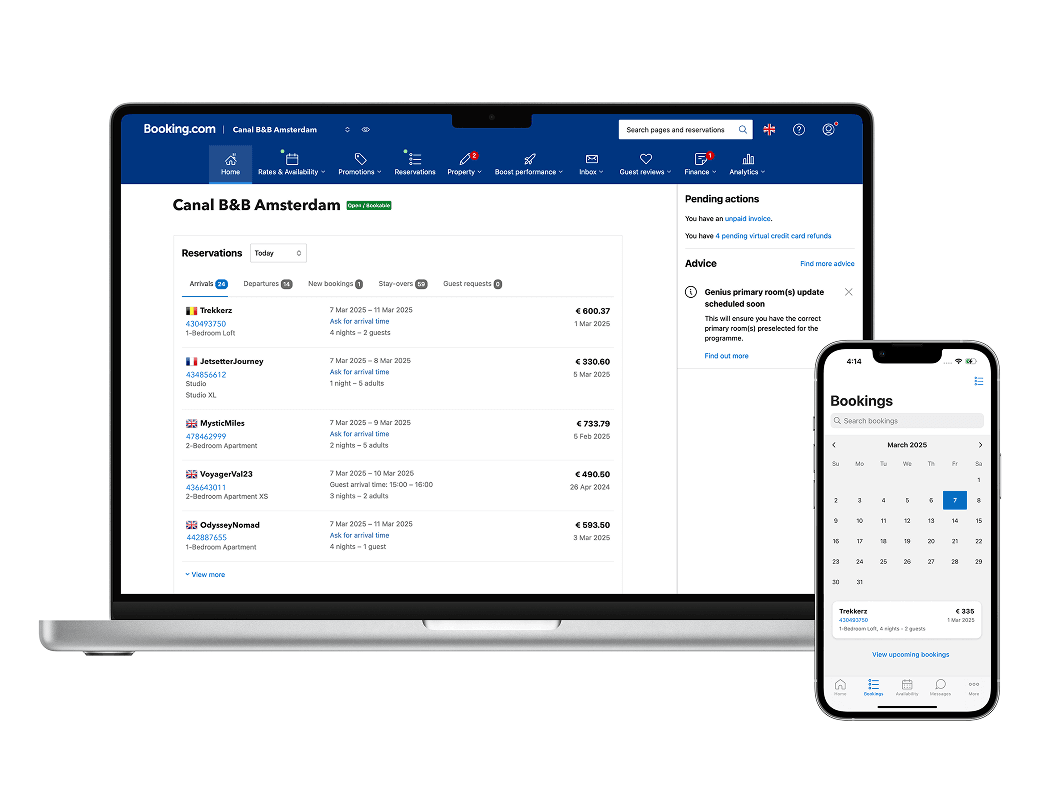
Quick answer: as of 2026 the fee gap between the two has effectively closed. Airbnb is moving every remaining host to a single 15.5% host-paid fee — 13 October 2026 for hosts in the EEA, Portugal included — which is roughly where Booking.com has always sat. So the decision is no longer about commission. It's about guest behaviour, cancellation risk, and who ends up holding the tourist tax. Most Portuguese hosts run both. Your AL compliance obligations are identical either way.
I host in Madeira and list on both. Here's what actually differs in 2026, and what doesn't.
What changed in 2026 (and why old comparisons are wrong)
Three things happened that make most Airbnb vs Booking.com articles out of date:
Airbnb ended the split fee. Under the old model you paid about 3% and your guest paid roughly 14–16.5% on top at checkout. Airbnb is replacing that with one fee of about 15.5%, taken entirely from your payout. Software-connected hosts were migrated through April 2026. Everyone else follows: 15 September 2026 outside the EEA, 13 October 2026 inside the EEA and Switzerland. Reservations confirmed before your switch date keep the terms they were booked under.
Rate parity is dead in the EEA. Portugal already banned wide parity clauses nationally, and the Digital Markets Act finished the job across all 27 member states from late 2024. You are no longer contractually obliged to match your Booking.com rate on your own site or another channel. Booking's ranking algorithm still quietly rewards parity — but the contract term is gone.
EU Regulation 2024/1028 applies from 20 May 2026. Status: IN FORCE. Platforms must verify your registration number before publishing a listing, and must report monthly activity data — nights booked, guest counts — to each member state's single digital entry point. In Portugal that number is your RNAL. A listing without a valid one can be removed. This applies identically to Airbnb and Booking.com, and it means the tax and tourism authorities now see your activity whether or not you report it.
Fees: the 2026 numbers
Airbnb | Booking.com | |
|---|---|---|
Model | Single host-only fee (mandatory in EEA from 13 Oct 2026) | Host-only commission, always has been |
Headline rate | ~15.5% of booking subtotal | 10–25%, typically ~15% |
What it's charged on | Nightly rate + cleaning, pet and extra-guest fees; not taxes | Nightly rate + fees added at booking; not city/tourist tax |
Guest-facing fee | None under the new model | None |
Optional extras | — | Preferred Partner ~+3%; Payments by Booking.com 1.1–3.1% processing |
Negotiable | No | Yes, especially with strong performance |
The practical consequence for Portuguese hosts: if you don't reprice before 13 October, your payout drops on every new Airbnb booking. Raising your rate by 15.5% roughly restores the old guest total; raising it by about 18.3% restores your old net. Airbnb's in-app adjustment tool targets somewhere in between.
Booking.com's stated commission also understates the real cost if you run Genius. A 10% Genius discount stacked on 15% commission means you keep about 76.5% of your listed rate, not 85%. Booking reworked Genius in early 2026 so that visibility is driven by a relevance algorithm rather than guaranteed by the discount — worth checking whether the discount you're funding is still buying you anything.
Cancellations: Airbnb's advantage has narrowed
This is the section that has aged worst in most guides.
Airbnb retired the Strict cancellation policy on 1 October 2025. Listings that used it were moved to Firm. The standard tiers are now Flexible, Moderate, Limited and Firm, with Firm the strictest generally available: full refund up to 30 days out, 50% between 7 and 30 days, nothing inside 7 days.
On top of that sits a universal 24-hour grace period — any stay under 28 nights booked at least 7 days before check-in can be cancelled free within 24 hours, and hosts cannot switch it off. Airbnb also took Reserve Now, Pay Later global in February 2026, letting guests hold a calendar with nothing paid upfront. Airbnb has acknowledged this raises cancellation rates.
Booking.com still generates more speculative bookings and more last-minute drops, and you're still charged commission on no-shows unless you flag them in the Extranet in time. But if you built your Portuguese season around Airbnb's old Strict policy, that protection no longer exists.
Tourist tax: the biggest practical difference
This one costs Portuguese hosts real money and almost nobody writes about it correctly.
In municipalities where Airbnb has a collection agreement — Lisbon and Porto are the commonly cited examples — Airbnb collects the municipal tourist tax from the guest and remits it to the council for platform bookings. You still handle it for every other channel.
Booking.com behaves differently in Portugal. It typically shows a "city tax" or "tourist tax" line at checkout, then pays that money to you along with the rest of your payout. Collected is not remitted. The declaration and payment to the câmara municipal remains yours. Hosts who assume the platform handled it can be several quarters behind without realising.
Verify your own situation rather than trusting a blog: check the payout breakdown on an actual booking from each platform. If the tax amount lands in your account, it's yours to declare.
Rates vary widely — Lisbon at €4 per person per night, Porto at €3, Funchal at €2, parts of the Algarve €1–2, most capped at 7 nights with under-13 exemptions. See the complete guide to the municipal tourist tax, the Lisbon city tax guide, the Funchal guide, and how tourist tax works across platforms.
Compliance: identical on both platforms
Neither platform handles your Portuguese legal obligations. This is the part that catches new hosts, and it does not change based on where the booking came from.
Obligation | Deadline | Who does it |
|---|---|---|
RNAL registration + number displayed on every listing | Before you advertise | You — via Balcão Único Eletrónico |
SIBA/AIMA guest bulletins (all foreign guests, including EU nationals and minors) | Within 3 working days of check-in | You. Fines run €100–€2,000 per unreported guest |
Monthly, including nil returns | You | |
Invoice or receipt via certified software | Per booking | You |
Tourist tax declaration and remittance | Per municipal regulation | You, except where the platform explicitly remits |
Annually | You |
Airbnb does not submit SIBA bulletins. Booking.com does not submit SIBA bulletins. Neither files your INE return. Start with how to register an AL in Portugal, then the SIBA/AIMA 2026 guide and whether EU guests need SIBA registration — the answer surprises people. The full picture is in the Portugal Alojamento Local legal guide 2026.
Full comparison
Category | Airbnb | Booking.com |
|---|---|---|
Platform character | Host-and-guest profiles, review-driven | Transactional, hotel-derived |
Fee model 2026 | ~15.5% host-only (EEA from 13 Oct 2026) | ~15% host commission, 10–25% range |
Fee negotiable | No | Yes |
Guest checkout price | Your price, no separate platform fee | Your price, commission built in |
Guest quality | Generally more engaged; reviews cut both ways | More price-led, more hotel-style expectations |
Messaging | Central to the booking; guests expect it | Exists but frequently ignored |
Cancellations | Firm is now the ceiling; 24h grace period universal; RNPL increases churn | Higher speculative cancellation rate; commission still due on unflagged no-shows |
Reach in Portugal | Strong, especially Lisbon, Porto, Algarve, Madeira | Very strong, particularly European drive and package markets |
Tourist tax | Collects and remits in some municipalities (Lisbon, Porto) | Typically pays it to you — you remit |
RNAL verification | Required under EU 2024/1028 | Required under EU 2024/1028 |
SIBA, INE, invoicing | Not handled | Not handled |
Best fit | Hosts who want engaged guests and a controlled check-in flow | Hosts filling shoulder season and midweek gaps |
Which one for your situation
Lisbon or Porto, one or two units: start with Airbnb. The tourist tax handling alone removes a monthly job, and guest communication is easier when you're managing remotely.
Algarve, seasonal: you probably need both. Booking fills the European drive market and shoulder season in a way Airbnb doesn't. Just price for cancellation risk.
Madeira or the interior: Booking tends to over-index here, particularly with Northern European travellers. Airbnb is still worth running for the guest quality, but don't expect it to carry your occupancy alone.
Just opened your AL: one platform is a perfectly sensible start. Learn your check-in flow, your first SIBA submission, and your tourist tax cycle without juggling two calendars. Add the second when the routine is boring.
Running both without doubling the admin
The reason hosts avoid dual-listing is double-entry, not double-listing. Two things fix most of it:
Sync the calendars properly. iCal is free and works, but the refresh gap between the two platforms is where double bookings happen — see how to sync Airbnb and Booking.com calendars.
Use one check-in link for both. If the guest fills in their details once, that data can feed your SIBA bulletin, your INE numbers and your tourist tax calculation regardless of which platform sent the booking. That's the whole reason EazyAL exists — I built it because I was typing passport numbers into three portals for bookings that came from two platforms.
FAQ
Is Airbnb or Booking.com better for hosts in Portugal? Neither wins outright in 2026. Fees are now comparable at roughly 15–15.5%. Airbnb gives you more engaged guests and, in some municipalities, handles the tourist tax. Booking.com gives you more volume and a negotiable commission. Most established Portuguese hosts run both.
How much does Airbnb charge hosts in Portugal in 2026? About 15.5% of the booking subtotal, deducted from your payout. Portugal is in the EEA, so the mandatory switch date is 13 October 2026. The fee applies to your nightly rate plus cleaning, pet and extra-guest fees, but not to taxes.
Do I need to raise my Airbnb prices before October 2026? If you want to keep the same payout, yes. Raising your rate by about 15.5% keeps the guest's total roughly where it was; about 18.3% restores your previous net. Do the sum including your cleaning fee, since that's now in the fee base too.
How much does Booking.com charge hosts? Commission typically sits around 15%, within a 10–25% range depending on country, property type and the programmes you join. Preferred Partner adds roughly 3%. Payments by Booking.com adds 1.1–3.1% processing. Unlike Airbnb, the rate is negotiable.
Does Airbnb or Booking.com collect the tourist tax in Portugal? Airbnb collects and remits in municipalities where it has an agreement, including Lisbon and Porto. Booking.com generally adds a tax line at checkout and pays it to you — you remain responsible for declaring and remitting it. Check an actual payout breakdown for your own property before assuming either way.
Does either platform register my guests with SIBA? No. SIBA/AIMA guest registration is entirely the host's responsibility, for every foreign guest including EU nationals and minors, within three working days of check-in. Fines run €100–€2,000 per unreported guest.
Do I have to display my RNAL number on both platforms? Yes. It has been a Portuguese requirement for years, and since 20 May 2026 EU Regulation 2024/1028 requires platforms to verify it before publishing. A listing without a valid number can be removed.
Can I charge less on my own website than on Booking.com? Yes. Portugal banned wide parity clauses nationally, and the Digital Markets Act removed both wide and narrow parity clauses across the EEA. Booking's ranking algorithm may still favour parity, but there is no contractual obligation.
Why does Booking.com have more cancellations? Guests frequently reserve several properties and decide later. Note that Airbnb's advantage here shrank in 2026: Strict was retired, a universal 24-hour grace period applies, and Reserve Now Pay Later lets guests hold dates with nothing paid.
I've just opened my AL and listed only on Airbnb. Too cautious? Not at all. One platform is a sensible way to learn your check-in flow, first SIBA submission and tourist tax cycle without managing two calendars. Compliance obligations are identical regardless. Add Booking once the routine is stable.
What's the biggest challenge after the bookings start? The admin behind them — guest registration, monthly INE returns, tourist tax remittance and invoicing. That's where hosts lose evenings and pick up fines, and it's the part neither platform touches.
Last updated: August 2026. Fee structures and cancellation policies change frequently — verify current terms in your Airbnb account and Booking.com Extranet. Regulatory information is for guidance only; confirm with your municipality, Turismo de Portugal or a qualified advisor.
Sources: Airbnb Resource Center announcement of 7 July 2026; Booking.com Partner Help; Regulation (EU) 2024/1028; Booking.com DMA compliance report.