Tourist Tax in Portugal 2026: How Tourist Tax Automation Works

Portugal's Municipal Tourist Tax — Taxa Municipal Turística or TMT — is not managed through one national system.
Unlike obligations such as SIBA or INE reporting, there is no single Portuguese tourist-tax portal covering every municipality.
Instead, each municipality decides whether to introduce a tourist tax, defines its own rules and determines how accommodation operators should register, declare stays and transfer the tax collected.
For an Alojamento Local host operating in only one municipality, this may simply mean learning one portal.
For a property manager operating across Portugal, however, the situation can become considerably more complicated.
A property in Sintra may have one municipal portal and workflow. Another property in Funchal may require a completely different system. A property in Ponta Delgada may follow another set of municipal rules again.
The important development in 2026 is that some of these municipal systems are beginning to become interoperable with the software hosts already use.
One of the companies pushing this approach is Portuguese technology group ACIN, through its municipal tourist-tax platform iTAXAS. ACIN now provides APIs and direct software integrations that can remove part of the repetitive work normally involved in submitting tourist-tax declarations.

Why Tourist Tax in Portugal Is So Fragmented
Portugal does not have one national tourist-tax rate.
The municipality itself determines whether it introduces the tax and its municipal tourist tax rules.
That means hosts may encounter differences in:
the amount charged per guest;
minimum guest age;
maximum taxable nights;
seasonal rates;
exemptions;
declaration deadlines;
payment deadlines;
zero-activity declarations;
registration procedures;
invoicing requirements;
collection commissions;
and the online platform used to submit the declaration.
The result is effectively a collection of municipal compliance systems rather than one Portuguese tourist-tax system.
This is particularly noticeable for managers with properties in several municipalities.
Imagine managing ten properties split between Madeira, the Azores, Lisbon and Northern Portugal.
Even if your reservations are already organised inside your property-management software, you may still need to take information that already exists there and manually re-enter it into several municipal portals every month.
That duplication is the problem integrations such as iTAXAS are beginning to address.
The Software Behind Portugal's Municipal Tourist-Tax Portals
Although municipalities maintain their own tourist-tax rules and portals, the technology behind those portals is often supplied by specialist Portuguese municipal-software companies.
Two names appear repeatedly:
ACIN — iTAXAS
ACIN - iCloud Solutions develops iTAXAS, a dedicated Municipal Tourist Tax management platform.
The system includes functions for overnight-stay registration, declarations, reporting, collection processes, communication with the municipality and management of any return or collection commission due to accommodation operators.
Medidata Software
The Problem With the Traditional Tourist-Tax Workflow
Consider a host whose reservations already exist inside Airbnb, Booking.com or a PMS.
The system may already know:
Property: Ribeira Brava Apartment
Arrival: 10 August
Departure: 15 August
Guests: 3
Guest ages: 38, 35 and 9
Taxable guests: 2
Taxable nights: 5
The tourist-tax calculation can already be made from that information.
Yet without an integration, the host may still have to:
log into the municipality's tourist-tax portal;
select the establishment;
enter the relevant accommodation information;
enter the number of taxable stays or guests;
enter exemptions;
calculate or confirm the declaration;
submit it;
repeat the process for another property;
repeat it again next month.
The problem isn't necessarily the complexity of one declaration.
It is the repetition.
If the relevant information already exists in another system, asking the host to enter it again creates unnecessary administration and another opportunity for mistakes.
What Is iTAXAS?
iTAXAS is ACIN's digital platform for managing Portugal's Municipal Tourist Tax.
It is used by municipalities as the system through which tourism businesses and Alojamento Local operators can manage their tourist-tax obligations.
Its modules include:
iTAXAS module | Purpose |
|---|---|
Overnight stays | Record stays and contribute to the monthly declaration |
Reports | View submitted and outstanding declarations |
Collection processes | Manage the process related to tourist-tax collection |
Messages | Communication between operators and municipalities |
Charge management | Manage commissions or amounts returned to operators |
Users | Give different users management or viewing permissions |
ACIN describes iTAXAS as a digital connection between municipalities and accommodation operators.
But one of its most interesting features for professional hosts is not the portal itself.
It is what happens outside the portal.
iTAXAS syncs with your Camara
ACIN has designed iTAXAS to integrate with external systems.
Its official website states that iTAXAS supports native integrations, REST APIs and webhooks, allowing other software to connect with the municipal tourist-tax infrastructure.
That changes the normal workflow significantly.
Instead of:
Reservation → host checks data → municipality portal → manual declaration
the workflow can become:
Reservation → management software → iTAXAS → municipality
The host's existing software can prepare the tourist-tax information and synchronise declarations with iTAXAS.
The objective is not simply to create another tourist-tax application.
It is to allow the systems hosts already use to communicate with the municipal system.
Which Municipalities Currently Use iTAXAS?
As of August 2026, ACIN publicly lists 13 Portuguese municipalities as part of the iTAXAS network.
Municipality | Region |
|---|---|
Vila do Conde | Northern Portugal |
Lisbon region | |
Northern Portugal | |
Algarve | |
Madeira | |
Madeira | |
Madeira | |
Azores | |
Azores | |
Azores | |
Azores | |
Azores | |
Azores |
ACIN's official iTAXAS page links directly to the individual tourist-tax portals operated for these municipalities.
This is especially interesting in Madeira and the Azores, where several municipalities are already using the same underlying infrastructure.
Madeira Municipalities Using iTAXAS
The iTAXAS network currently includes three Madeira municipalities:
Madeira municipality | iTAXAS |
|---|---|
Yes | |
Calheta | Yes |
Santana | Yes |
That means a property manager operating AL properties across these municipalities can potentially use an integrated system rather than treating every municipality as an entirely separate manual process.
Other Madeira municipalities may use different tourist-tax systems, however, so the existence of tourist-tax automation in one municipality does not mean the same integration is available everywhere on the island.
The Azores Have Particularly Strong iTAXAS Coverage
The current iTAXAS list includes:
Ponta Delgada;
Ribeira Grande;
Vila Franca do Campo;
Nordeste;
Lagoa;
Povoação.
For property-management companies operating across São Miguel, this creates an interesting opportunity.
Instead of designing completely different workflows for every council, several municipalities can communicate through the same underlying iTAXAS infrastructure.
The tax rules themselves may still differ, but the mechanism used to communicate the declaration becomes much easier to integrate into existing software.
Which Alojamento Local Tools Integrate With iTAXAS?
ACIN's current public integration page specifically identifies:
EazyAL
Hostkit
as Local Accommodation management platforms with direct iTAXAS integration. ACIN describes the functionality as automatic synchronisation of declarations.
The platform also publicly lists integrations with Medidata and AIRC in the ERP category and provides a process through which additional software providers can request an integration.
This is an important distinction.
The automation is not limited to software owned by ACIN.
ACIN has provided an integration layer so that independent AL and hotel-management systems can connect to the municipal infrastructure.
How EazyAL Uses the iTAXAS Integration
For an EazyAL user in a supported municipality, the goal is to remove the need to repeat information already collected elsewhere in the workflow.
EazyAL can organise reservation and guest information, determine the relevant tourist-tax calculation and use its integration with iTAXAS to synchronise the declaration with the municipal system.
The host therefore does not need to treat the municipality's portal as another completely separate database that must be manually maintained.
Conceptually, the flow becomes:
Airbnb / Booking.com / reservation
↓
Guest and stay information
↓
EazyAL
↓
Tourist-tax calculation
↓
iTAXAS integration
↓
Municipality
ACIN itself now displays EazyAL as one of the platforms with direct iTAXAS integration.
How to integrate EazyAL with iTAXAS
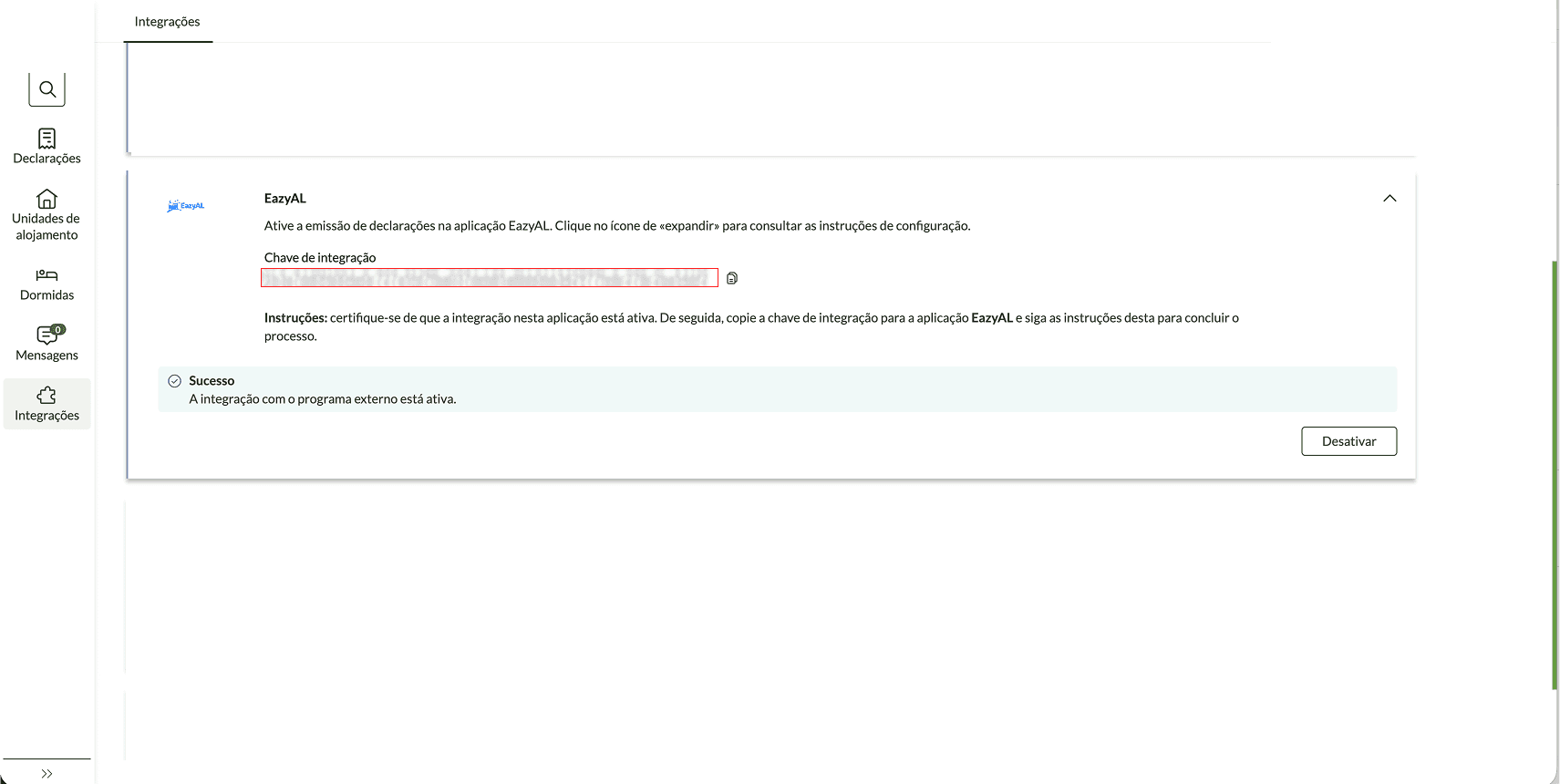
In order to integrate your municipality Tourist tax portal with EazyAL.
Login
In the side bar , click integrations
In the EazyAL section , expand the box by clicking the arrow
Copy the integration key
Paste in EazyAL compliance hub , Tourist Tax with iTaxas
What the Integration Does Not Change
Automation does not mean Portugal suddenly has one national tourist tax.
The municipality remains responsible for its own tax.
The local rules can still determine:
rate;
age threshold;
maximum nights;
exemptions;
seasonality;
reporting frequency;
payment procedure;
collection commission.
An integration therefore needs to respect the configuration of the municipality in which the accommodation is located.
For example, if Municipality A charges one rate and Municipality B charges another, an API does not make those tax rules identical.
It makes it easier for software to communicate the correct information to each municipality.
That is an important difference.
Why This Is a Better Model for Portuguese AL Compliance
Much of Alojamento Local compliance involves the same underlying information being reused.
A reservation can contain:
guest identity;
nationality;
arrival;
departure;
number of guests;
revenue;
channel;
commission.
Different authorities then ask for different subsets of that information.
The inefficient approach is:
collect the information once and manually re-enter it five times.
A better model is:
collect the information once and use it wherever legally required.
That is particularly relevant for tourist tax.
The host already knows who stayed at the property.
The reservation system already knows the dates.
The guest form can already know the guest's age.
The property record already knows the municipality.
The software can therefore calculate the applicable tax and prepare the relevant declaration without asking the host to reconstruct the stay manually each month.
Portugal Is Moving Toward Connected Compliance
The interesting development here is larger than tourist tax.
Portugal's accommodation sector has historically had many separate administrative systems:
SIBA for foreign-guest reporting.
INE for tourism statistics.
Municipal portals for tourist tax.
AT-certified invoicing systems for invoices.
Portal das Finanças for other fiscal declarations.
And hosts frequently maintain separate Airbnb, Booking.com and PMS systems on top of those government portals.
The opportunity is not necessarily to replace the official systems.
It is to connect them.
iTAXAS is a good example of what this can look like.
The municipality retains its official platform and its own rules, while approved external tools can connect through an API.
That gives professional hosts the possibility of maintaining one operational workflow while still communicating with the municipality's official infrastructure.
What About Municipalities That Don't Use iTAXAS?
This remains the main limitation.
Portugal's tourist-tax infrastructure is still fragmented.
Some municipalities use iTAXAS.
Others use platforms developed by companies such as ANO Software. ANO describes its own Tourist Tax Platform as a permanent digital channel between municipalities, tourism enterprises and Alojamento Local establishments, and says it has deployed the technology in several municipalities around Portugal.
Other municipalities have different systems again.
This means a software provider cannot necessarily build one integration and instantly automate every tourist-tax municipality in Portugal.
Each technical platform needs to provide an appropriate way for external systems to communicate with it.
That is why ACIN's API approach is significant.
Why Other Municipal Platforms Should Follow
From the host's perspective, the municipality does not lose anything by allowing structured integrations.
The declaration still reaches its official system.
The municipality still controls:
its regulation;
tax rates;
exemptions;
deadlines;
validation;
accounts;
collection.
What changes is how the information gets there.
Instead of forcing every operator to manually type the data through a web interface, an API allows authorised software to transmit the same structured information.
For a professional property manager with 20, 50 or 100 properties, that can represent a considerable reduction in monthly administration.
It can also reduce transcription errors because information does not need to be repeatedly copied between different systems.