SIBA, SEF ou AIMA? Guia de 2026 para Anfitriões de AL
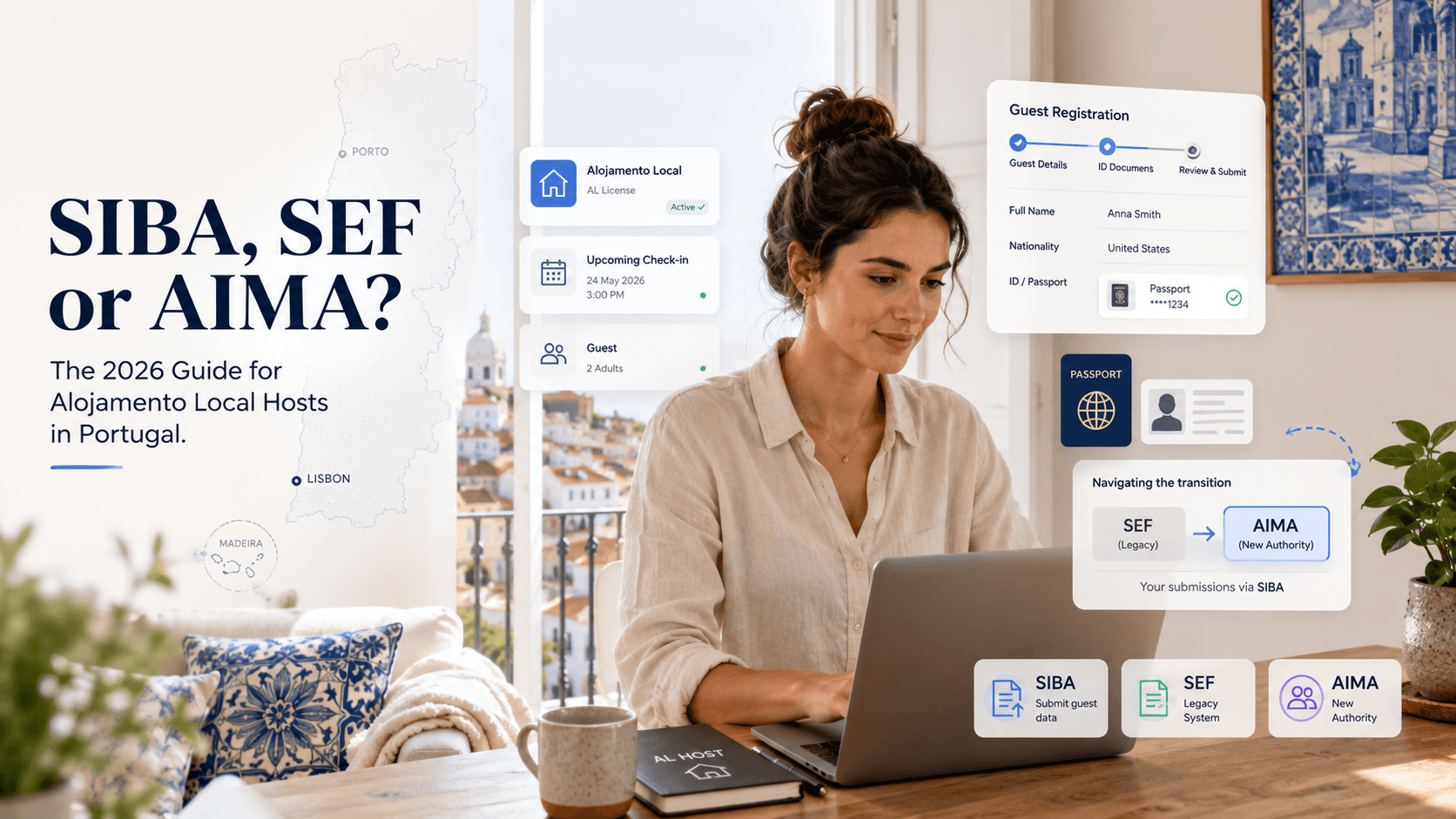
Se gere um Alojamento Local em Portugal e acolhe hóspedes estrangeiros, o seu dever prático de envio em 2026 continua a ser o Boletim de Alojamento através do SIBA. As raízes legais são mais antigas e ainda se referem fortemente ao SEF, mas Portugal extinguiu o SEF e transferiu as competências administrativas de migração para a AIMA, criando também a UCFE no âmbito do Sistema de Segurança Interna. O resultado é a origem da maior parte da confusão dos anfitriões: as pessoas continuam a dizer "comunicação ao SEF", alguns fornecedores de software dizem agora "SIBA/AIMA", mas o portal operacional atual é o SIBA, a autoridade pública atual nomeada no portal é a UCFE, e o e-mail de suporte atual do SEF é siba@ssi.gov.pt.
Para um anfitrião, a regra de conformidade é simples. Se disponibiliza alojamento temporário pago a hóspedes estrangeiros, incluindo cidadãos da UE, deve registar-se no SIBA e comunicar tanto a chegada como a partida no prazo de três dias úteis. Este dever aplica-se quer a atividade seja regular ou ocasional, e não se aplica aos arrendamentos residenciais habituais de longa duração.
Resumo rápido
O caminho prático mais rápido, se acabou de receber a sua licença de AL, é: obter o seu número de registo RNAL/AL, registar o imóvel no SIBA, selecionar o seu método de envio preferido, recolher os dados dos hóspedes legalmente exigidos antes ou no momento do check-in, e ir verificando a carta de comprovativo gerada após o envio da lista de boletins. O incumprimento pode levar a coimas que começam nos €100–€500 para 1–10 boletins ou registos de hóspedes em falta e aumentam para omissões maiores, embora o atraso por negligência no envio seja tratado com maior tolerância.
Vale a pena colocar na sua parede uma pequena lista de verificação para o anfitrião:
Registe o seu AL e anote o seu número RNAL. O SIBA pede agora explicitamente às unidades de AL que incluam o RNAL no momento do registo, e o gov.pt refere que deve registar o AL antes de iniciar a atividade.
Abra uma conta SIBA antes da chegada do seu primeiro hóspede estrangeiro. O registo no SIBA é obrigatório para alojamento temporário pago a cidadãos estrangeiros.
Recolha os dados de identificação do hóspede, nacionalidade, país de residência e datas de check-in/check-out. Estes são os campos principais do BA publicados pelo SIBA.
Submeta a chegada e a partida no prazo de três dias úteis cada uma. A contagem é feita por dias inteiros, independentemente da hora de check-in.
Guarde ou verifique a carta de comprovativo emitida. O SIBA indica que o “ofício” gerado é a sua confirmação de que a lista de boletins foi recebida corretamente.
Trate a taxa turística, a comunicação ao INE e o SIBA como obrigações distintas. Sobrepõem-se operacionalmente, mas não são a mesma entrega.
SIBA, SEF ou AIMA em 2026
A base legal do SIBA ainda começa com a Lei n.º 23/2007 de Portugal, a lei de estrangeiros. O artigo 15.º diz que o boletim de alojamento existe para permitir o controlo de cidadãos estrangeiros em território português, e que para cada cidadão estrangeiro, incluindo nacionais de outros Estados-membros da UE, deve ser preenchido e assinado pessoalmente um boletim. O artigo 16.º atribui então o dever de comunicação aos estabelecimentos hoteleiros e, crucialmente para os anfitriões de AL, a todos os que proporcionem alojamento pago a cidadãos estrangeiros, devendo a comunicação ser feita no prazo de três dias úteis após a chegada e novamente no prazo de três dias úteis após a partida.
O que é um boletim do SEF?
Esta linguagem jurídica mais antiga é a razão pela qual muitos anfitriões ainda falam de um "boletim do SEF". O sistema original foi desenhado em torno do SEF, e manuais mais antigos, nomes de domínio e artigos do setor ainda refletem essa história. Mesmo o manual em inglês do SIBA disponível online ainda utiliza o antigo domínio siba.sef.pt e ainda menciona siba@sef.pt em partes do texto, o que mostra quão persistente continua a ser a terminologia herdada.
O panorama institucional mudou após Portugal reestruturar a administração das migrações. O Decreto-Lei n.º 41/2023 criou a AIMA e tornou-a a sucessora do SEF nas competências administrativas de migração e asilo, ao mesmo tempo que criou a UCFE dentro do Sistema de Segurança Interna. Uma resolução do Conselho de Ministros de 2024 também resumiu que os assuntos administrativos e de cidadãos estrangeiros transitaram para a AIMA. Ao mesmo tempo, as regras atualizadas do SIBA e o portal ativo do SIBA instruem agora os anfitriões a registarem-se na UCFE e a submeterem eletronicamente através do SIBA.
SEF é o nome antigo, AIMA é a nova agência de migrações
Portanto, em bom português: SEF é o nome antigo, AIMA é a nova agência de migrações, mas o SIBA em si continua a ser o sistema prático voltado para o anfitrião, gerido em torno da UCFE/SSI para o envio do boletim de alojamento. Esta conclusão é uma inferência das fontes legais e operacionais atuais em conjunto: a lei de transição retirou as competências ao SEF, mas as FAQ e a página de contactos atuais do SIBA continuam a dizer aos anfitriões para procederem ao envio diretamente para a UCFE através do SIBA.
Esta transição institucional não tem sido isenta de atritos. A Provedora de Justiça relatou que acompanhou a transição do SEF para a AIMA e alertou explicitamente para problemas de interoperabilidade e continuidade durante e após a transição. Isso importa aos anfitriões porque ajuda a explicar por que razão alguns materiais oficiais, portais e rótulos de software ainda parecem inconsistentes em 2026.
As fontes prioritárias apontam globalmente no mesmo sentido. O portal ativo do SIBA/SSI indica que as unidades de AL devem fornecer o número RNAL no momento do registo. O domínio legado do SEF ainda encaminha para o conteúdo do SIBA. E o explicador do Portugal Resident, embora mais antigo, é resumido nos resultados de pesquisa como um guia para as obrigações de comunicação de AL ao SEF e afirma que os cidadãos estrangeiros, incluindo os nacionais da UE, devem preencher um boletim de alojamento em alojamentos elegíveis. Isto é consistente com a lei e com as FAQ atuais do SIBA.
Uma consequência prática importante decorre do artigo 14.º da lei de estrangeiros. Os cidadãos estrangeiros que entrem em Portugal vindos de outro Estado da UE têm normalmente de fazer uma declaração de entrada no prazo de três dias úteis, mas esse dever não se aplica quando, imediatamente após a entrada, fiquem alojados em estabelecimentos sujeitos ao dever do boletim do artigo 16.º. Por outras palavras, o seu envio ao SIBA ajuda a satisfazer parte da cadeia de comunicação de entrada do hóspede.
Quem deve submeter e de que informações necessita
As FAQ atuais do SIBA são invulgarmente claras. O registo é obrigatório para entidades que forneçam alojamento temporário a cidadãos estrangeiros mediante pagamento, quer a atividade seja regular ou ocasional. Define alojamento temporário como estadias com datas de chegada e partida identificadas, e refere que a regra não se aplica a arrendamentos residenciais de longa duração. As mesmas FAQ dizem expressamente que quem arrendar quartos, frações de uma casa ou a totalidade da propriedade como apartamento ou moradia deve comunicar os hóspedes estrangeiros à UCFE através do SIBA e deve registar-se sob a designação de “Alojamento Local/apartamento” no registo da unidade.
Para um anfitrião de AL recém-licenciado, a questão do momento é simples: registe-se antes do check-in do seu primeiro hóspede estrangeiro. A página principal do SIBA avisa que as unidades de AL devem incluir o seu número RNAL no registo do SIBA, enquanto o gov.pt confirma que o próprio AL deve primeiro ser registado através do processo municipal/serviços públicos.
O prazo legalmente relevante também é simples: três dias úteis após a chegada, e três dias úteis após a partida. As FAQ do SIBA acrescentam um detalhe operacional importante na vida real: a contagem é feita em dias inteiros, a partir da data de alojamento ou de partida, independentemente da hora em que o registo foi efetuado.
Os dados dos hóspedes que deve considerar como o mínimo legal a recolher são os seguintes. O primeiro grupo está listado explicitamente pelo SIBA como obrigatório; o segundo grupo está marcado como opcional na documentação técnica atual.
Campo do hóspede | Estado | Nota prática |
|---|---|---|
Nome completo | Obrigatório | Os documentos técnicos do SIBA dividem este campo em apelido e nome próprio em alguns formatos. |
Nacionalidade | Obrigatório | Utilize as regras de códigos de país publicadas pelo SIBA para métodos baseados em ficheiro. |
Data de nascimento | Obrigatório | Se o documento não tiver mês/dia, o SIBA indica que se assuma 1 de janeiro. |
Número de identificação/passaporte | Obrigatório | Alfanumérico; aplicam-se regras exatas de formatação nos métodos de ficheiro/XML. |
Tipo de documento | Obrigatório | Passaporte, bilhete de identidade/cartão de cidadão ou outro documento. |
País emissor do documento | Obrigatório | Código de país exigido em métodos estruturados. |
País de residência | Obrigatório | Diferente da nacionalidade, se aplicável. |
Data de check-in | Obrigatório | Deve ser o dia de hoje ou anterior no momento do envio. |
Data de check-out | Obrigatório nas FAQ do anfitrião | O texto técnico atual do XML ainda a descreve como opcional em algumas estruturas de ficheiro até que a partida seja conhecida; operacionalmente, a partida deve ser comunicada dentro do prazo. |
Naturalidade (Local de nascimento) | Opcional | Útil se o seu fluxo de trabalho a capturar de forma simples. |
Local de residência | Opcional | Campo opcional nas orientações publicadas pelo SIBA. |
Esta tabela consolida as FAQ atuais voltadas para o anfitrião e as especificações técnicas de campos publicadas pelo SIBA. Nos casos em que as FAQ e as notas de formato técnico diferem ligeiramente, a abordagem mais segura é recolher dados suficientes para comunicar tanto a chegada como a posterior partida sem voltar a contactar o hóspede.
Se acolher uma família ou grupo, a lei suaviza apenas a regra da assinatura: um dos cônjuges ou um membro do grupo pode satisfazer a obrigação de assinatura pessoal pelo grupo. Isto não elimina o dever de comunicação subjacente para os restantes hóspedes estrangeiros alojados no imóvel.
As coimas não são teóricas. O artigo 203.º da Lei n.º 23/2007 refere que a falta de registo eletrónico ou a falta de boletins constitui uma contraordenação punível com coimas de €100–€500 para 1–10 boletins/hóspedes omitidos, €200–€900 para 11–50, e €400–€2000 para mais de 51; o atraso por negligência reduz os limites da coima.
Como registar e submeter na prática
O fluxo de trabalho oficial começa na área reservada do portal do SIBA. O manual do utilizador em inglês indica que deve entrar na área reservada, escolher Inscrição, preencher o formulário de registo, escolher o seu método de envio e submeter. Recomenda vivamente que o e-mail de contacto esteja correto, pois é para aí que serão enviados a chave de ativação e os e-mails de comprovativo. O SIBA envia então um e-mail a confirmar o registo e refere que a chave de ativação será enviada no prazo de 48 horas.
As três vias práticas atuais de submissão estão descritas na ajuda técnica do SIBA:
Webservices para comunicação software-para-SIBA sem intervenção humana.
Upload de ficheiro para ficheiros gerados por software carregados na área reservada.
Inserção manual no portal através de Entrega de Boletins → Registo de Boletins pelo Portal.
O texto legal atualizado é ligeiramente mais formal na linguagem, mas aponta no mesmo sentido: aos titulares registados são disponibilizadas vias de comunicação eletrónica que incluem ficheiros produzidos por software e o envio de formulários online.
Se for um pequeno anfitrião com um ou dois imóveis, a inserção manual no portal é normalmente o início mais simples. O manual indica que deve criar uma nova lista de entrega, abrir a lista enquanto está “Em edição”, adicionar os dados dos boletins, guardar cada boletim e depois enviar a lista. Após a submissão com sucesso, o SIBA gera um ofício comprovativo oficial, que pode ser consultado mais tarde em Consulta de Ofícios Emitidos.
Se utiliza um PMS ou gestor de canais (channel manager), a via profissional mais eficiente é normalmente o webservice.
Erros comuns e como evitá-los
O erro mais comum dos principiantes é adiar o registo até ao momento em que o primeiro hóspede já chegou. Não faça isso. O portal exige que as unidades de AL registem o RNAL, e o fluxo de ativação pode demorar até 48 horas. Se acabou de obter uma licença de AL, encare o registo no SIBA como uma tarefa para o primeiro dia, e não para o final da semana.
Um segundo problema comum é a confusão causada por designações antigas. Alguns documentos ainda dizem SEF, algumas páginas de software dizem agora SIBA/AIMA, e o suporte atual utiliza SSI/UCFE. Em caso de dúvida, siga o portal do SIBA ativo e a página de contactos do UCFE, e não capturas de ecrã antigas. O e-mail de suporte atual para assistência, substituição de chave de ativação, alteração de métodos ou pedidos de desativação é siba@ssi.gov.pt.
Um terceiro erro é assumir que "a ausência de confirmação significa que provavelmente funcionou". O SIBA refere que a forma prática de confirmar a receção com sucesso é o ofício comprovativo gerado em Consulta de Ofícios Emitidos. Se não o vir após o envio, verifique aí antes de assumir que o boletim foi aceite.
SIBA, taxa turística, INE e privacidade
O SIBA é apenas uma de várias obrigações de conformidade que um anfitrião de AL pode enfrentar. A taxa turística é normalmente uma obrigação municipal, não fazendo parte do envio do SIBA em si. O INE/IPHH é um fluxo de comunicação estatístico, também separado. O guia do AL do Turismo de Portugal refere que o INE pode exigir que os operadores de AL forneçam informações estatísticas mensais, incluindo o número de hóspedes e dormidas, e aponta o IPHH como exemplo. As instruções atuais do formulário Webinq do INE referem que os estabelecimentos abrangidos devem responder mensalmente até ao dia 10, mesmo quando não houve movimento de hóspedes nesse mês.
O ponto de interação é mais a nível operacional do que na identidade legal. A mesma reserva pode gerar uma obrigação do SIBA, um cálculo da taxa turística e uma estatística do INE/IPHH, mas não são entregues no mesmo local. As próprias instruções do INE sublinham que a taxa turística é separada ao indicar que os valores das receitas de alojamento devem ser comunicados sem IVA e sem a taxa turística municipal. Alguns fornecedores portugueses de PMS comercializam agora precisamente esta separação: por exemplo, a AvaiBook anuncia tanto a comunicação automática ao SIBA/AIMA como um fluxo de trabalho separado de calculadora/comunicação da taxa turística.
Quanto à privacidade, o aviso oficial do RGPD no SIBA é invulgarmente específico. Refere que a UCFE é a responsável pelo tratamento dos dados pessoais dos BA, que a base jurídica é o cumprimento de uma obrigação legal, que a finalidade é o controlo de cidadãos estrangeiros em território nacional e que a unidade de alojamento transmite os dados de forma segura à UCFE através do SIBA. Refere ainda que a unidade de alojamento não conserva os dados pessoais inseridos no SIBA, que os dados são conservados por um ano a contar do dia seguinte ao da comunicação da partida do hóspede, e que o hóspede pode exercer os direitos do RGPD através do contacto de proteção de dados da UCFE.
Para os anfitriões, a lição prática do RGPD é simples: recolha apenas o que necessita para fins legais e operacionais, utilize um formulário de check-in seguro ou um PMS seguro, evite armazenar cópias desnecessárias de passaportes ou fotografias ad hoc no WhatsApp indefinidamente, e restrinja o acesso da equipa aos dados dos hóspedes. O guia da CNPD para PMEs é um complemento geral útil ao aviso de privacidade específico do SIBA, pois destina-se a ajudar as pequenas empresas a cumprir o RGPD na prática do dia a dia.
Lista de verificação para o anfitrião e modelo de formulário de hóspede
Se acabou de receber a sua licença de AL e ainda não se inscreveu no SIBA, esta é a ordem prática que o manterá em conformidade:
Crie o seu registo no SIBA imediatamente, utilizando o e-mail de contacto correto do imóvel.
Escolha a sua via de envio: portal manual primeiro, ou webservice se o seu PMS/gestor de canais o suportar.
Recolha os dados obrigatórios dos hóspedes antes da chegada ou no check-in.
Comunique a chegada no prazo de três dias úteis.
Verifique se o ofício comprovativo existe no SIBA.
Comunique a partida no prazo de três dias úteis após o check-out.
Trate da taxa turística e do INE/IPHH separadamente, caso se apliquem no seu município ou na amostra do INE.
Um modelo limpo de recolha de informações do hóspede, baseado diretamente nos campos publicados pelo SIBA, pode ser assim estruturado:
Esse modelo é deliberadamente minimalista e segue a lista de campos obrigatórios e opcionais do SIBA. Para automatização, a melhor versão é normalmente um formulário de pré-check-in online que alimenta o seu PMS e, quando disponível, o seu fluxo de trabalho de webservice do SIBA.
Conclusão
O ponto essencial para 2026 é este: se é um anfitrião de AL em Portugal, não espere que a terminologia se torne perfeita. O sistema oficial continua a ser o SIBA, a obrigação continua a existir, os prazos continuam a ser de três dias úteis tanto para a entrada como para a saída, e a mentalidade mais segura para o anfitrião é tratar a "comunicação ao SEF", o "envio ao SIBA" e a "automatização SIBA/AIMA" como designações diferentes que orbitam a mesma obrigação de conformidade.
Siga o portal do SIBA atual e os contactos da UCFE, registe-se atempadamente, recolha os dados corretos de uma só vez e verifique cada submissão.
FAQ
1. O SIBA AIMA é o mesmo que o SEF Portugal?
Sim. O departamento foi renomeado de SEF para SIBA AIMA.